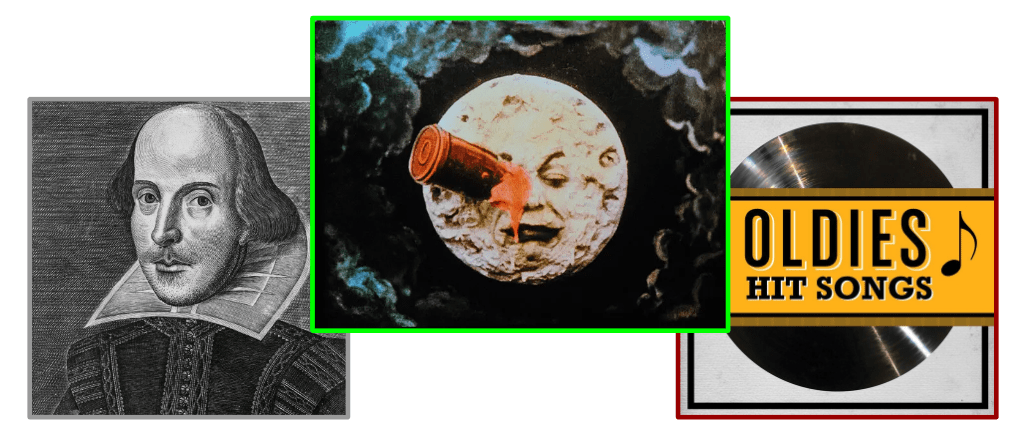
We see it in Star Trek and other sci fi media, references to the popular culture of the twentieth and early twenty-first centuries. Are these references to be avoided or embraced when writing of the distant future? They connect with the reader (at least with our contemporary readers) and can provide moments of levity or short-hand for certain subjects. But does it make sense that hundreds of years from now humanity will still value the same media?
Shakespeare died more than four hundred years ago. Star Trek references his works as often and more famously than works of our time. Shakespeare’s plays are still performed today, so it feels natural to continue to quote him in the twenty-third or twenty-fourth centuries. And, in case six or seven hundred years seems like too far a stretch, Medea by Euripides (431 BC) is also performed today. That’s two thousand four hundred years! Euripides is not as popular at The Bard, but that’s a lot of staying power for a text that isn’t religious or an historical account.
It’s hard to guess what in our time will last as long as these works. Certainly many things will. When an author chooses to refence some popular work from our time are they declaring it a classic? Sticking with Star Trek as the easiest example, the songs of the Beastie Boys are called classic music in the rebooted-original-show movie series. Steppenwolf’s “Magic Carpet Ride” (1969 AD) is recognized by The Next Generation crew when Zefram Cochrane plays it for them in 2063 AD. A character from the twenty-fourth century sings Pat Benatar’s “Shadows of the Night” (1982 AD) from memory in Picard (that had me howling just as hard as “Magic Carpet Ride” in First Contact). Were these chosen for their potential to stand the test of time? No, I think they were chosen because they fit the mood of the scene, the tastes of the director, and their ability to connect with the contemporary audience.
As a science fiction author writing about a distant future, should I eschew all references to my own time for the sake of veracity? Why would someone in the twenty-eighth century know anything about the Beach Boys? Or should I try and figure out which media will stand the test of time?
I think it will be much more fun to do the latter! So this is the first post in a series where I will examine this relationship between popular and classic, at least in my own view of the world.
 Arthur P. Dutton