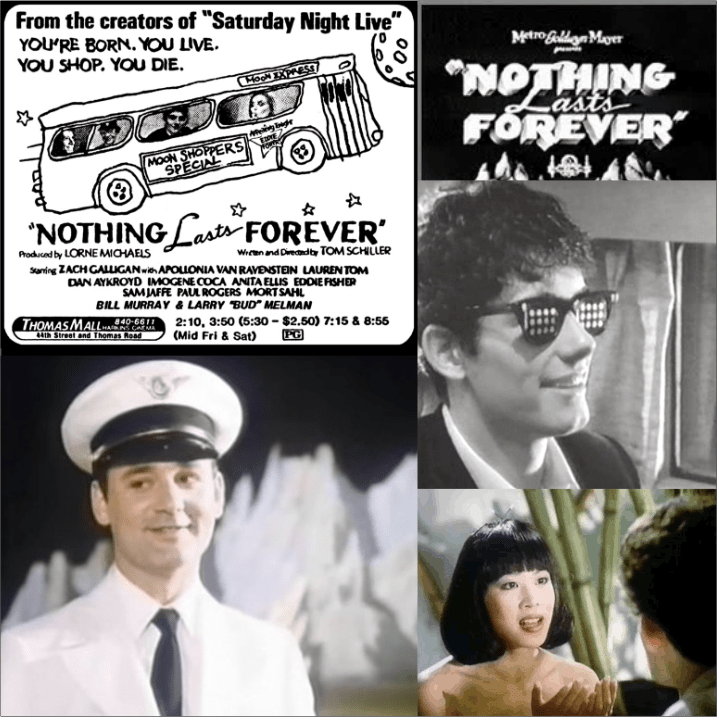
I recently found and watched the lost 1984 classic Nothing Lasts Forever. Directed by Tom Schiller and featuring two of my favorite comedic actors, Bill Murray and Dan Aykroyd, this was the director’s first feature film and the first feature film produced by Saturday Night Live’s Lorne Michaels. Billed as a sci-fi comedy-drama (we might say ‘dramedy’ these days), the film was completed but never released. This is my review.
Here is your spoiler warning for a 40-year-old film that you almost certainly haven’t seen but are equally unlikely to ever see: If you think you will seek out Nothing Lasts Forever and don’t want to know more, stop reading and come back after you’ve seen it (better bookmark this page!).
A nearly-innocent, melancholy-but-hopeful fantasy about a young man who wants to be an artist, Nothing Lasts Forever is an art film disguised as an homage to film’s golden age. It’s never depressing, obscuring that emotion in the natural comedy of the art scene, but neither is it entirely uplifting in the triumphal moments. Those moments are so bizarre that they blunt the emotional impact as you laugh or puzzle at their meaning. This is probably where the film fails to be great, but it comes oh-so-close.
The film opens on a fever dream, the main character’s nightmare about failure and imposter syndrome. Adam Beckett wakes to find himself on a train in Europe, a creepy man across from him watching him sleep. The watcher is the film’s prophet and tells Beckett that he will ‘find his art’ but not in the way he expects. (Of course, no one would expect to find their art by taking a bus trip to the moon unless they’ve consumed dangerous amounts of LSD.)
Beckett returns to his home country, but not his home. He goes to New York city, presumably the best place to pursue an artistic career, but perhaps the only place for him since Los Angeles has been destroyed in a wonderful voiced-over, stock footage montage. His aunt and uncle live in the city, so he has a place to stay, but the New York Port Authority has imposed fascist rule in order to deal with a labor strike. That means testing and worker placement for young Adam, and only a slim chance to be assigned as an artist.
On the way to take his art test, Adam gives his breakfast to a man we are meant to perceive as a worthless vagrant. It’s not an unnecessary ‘save the cat’ moment (the character is already likable, if dim), as the vagrant will be revealed as his spiritual guide later in the film (and that the vagrant is something more is immediately apparent to the audience). The test itself is more about the bureaucracy around the test and serves to demonstrate that the Port Authority’s fascism is borne out of incompetence rather than malice. Of course, Beckett fails the test and is assigned to work at the entrance to the Holland Tunnel.
Adam is ever-so-briefly ‘trained’ by Dan Aykroyd’s Bronx-accented supervisor (if you’ve seen Ghostbusters II you’ve seen this Akroyd character in the scene where the Ghostbusters are questioned by the police about the unauthorized hole they’ve drilled into the street). He also meets his first love interest, a fellow aspiring artist who likewise failed her art test. She encourages Beckett to find his art and they spend their off-time together exploring the New York art scene and having sex. Adam may be falling in love, but she’s just living in the moment.
Despite some nudity and a brief sex scene, Adam Beckett (played by Gremlins star Zach Galligan) is so sincere, kind, and innocent that the movie never feels purient. That’s why I called the movie ‘nearly-innocent’. His sincerity pays off. The vagrant reappears as his spiritual guide, congratulates Beckett on his commitment to finding his art, and initiates him into the great mystery of New York at the heart of the story.
Adam Beckett is cleansed and robed in a white cloth before he descends beneath the city with his guide to meet Father Knickerbocker. This minor diety controls the fate of New Yorkers and tells Beckett that he must travel to the moon so that the spiritual network of this secret organization can be extended to the moon’s inhabitants. Furthermore, Adam learns that he is destined to fall in love with a woman of the moon.
(Long aside on Father Knickerbocker: I knew the name had a New York connection and is the basis for their basketball team name, The Knicks, but I researched more after the screening. The real story is that of a wonderful literary hoax wherein Washington Irving wrote his first novel as a fake history of New York under the pseudonym Diedrick Knickerbocker in 1809. He created a buzz for the book by telling newspapers that the non-existent author had mysteriously disappeared. The book and the story were so popular that anyone of New York Dutch descent and, later, any resident of Manhattan became known as ‘Knickerbockers’. As a fan of literary hoaxes, I appreciate this deep cut.)
Beckett is sent back to the surface and rushes back to his girlfriend’s apartment. He bursts in, excited to tell her about his adventure, only to discover that she is cheating on him. Adam is hurt, but the discovery frees him from the relationship and allows him to head to the moon… on a bus.
The movie gives us the why and how of this secret lunar transit system, but it boils down to forcing elderly New Yorkers to shop while the government studies them. The trip itself is quite lovely and introduces the film’s only manifest antagonist, Bill Murray’s Sky Host (and he’s just doing his job). Murray is charming and smarmy and slightly threatening as he chews scenery. The bus must be Tardis-like as it’s akin to a cruise ship on the inside, including a dining room, a dance floor, and a live performance by singer Eddie Fisher (Carrie’s dad).
The moon itself is space-Hawaii. There is an atmosphere, normal gravity, and moon-women (early colonizers killed all the moon-men) performing hula dances and giving out leis. There is an instant connection between Adam Beckett and one of these moon-women, Eloy (a nice nod to H. G. Wells’s Time Machine). They escape the guided tour but know they will have little time before their absence is discovered.
During the lunar sequences, there are a few passing references to the Apollo missions serving as cover for the government’s ongoing shenanigans on the moon, which was colonized in the 1950s. I watched the movie with my wife and our seventeen-year-old son. Throughout the screening, we speculated on the year the movie was set in. The style, the alternating use of black and white and color, and the tone all point to film’s golden age, circa 1938. But many of the trapping of New York’s art scene and the references to the real moon landings are solidly 1984. Our son decided it was supposed to be something like a science fiction story created in 1938 about 1984 and I think that captures the unique style of the film.
Adam and Eloy share one perfect moment before Bill Murray and his goons catch up to them. The Sky Host punches Beckett out. Adam falls back to Earth, but all is not lost. He has a new perspective and a new purpose – he has found his art. Beckett’s spirit guide takes him to Carnegie Hall to perform (he’s a pianist). At the end of the show, to rapturous applause, Eloy and Beckett are reunited.
We all enjoyed the film and our son immediately started analyzing it as an exemplar of alchemical allegory. Nothing Lasts Forever certainly fits that tradition (of which I was unfamiliar), but I also see in it the older tradition of initiation into mystery stories, such as The Odyssey. Since it is a film, I’d rather compare it to similar films, in this case two films featuring Tom Hanks – Joe Versus the Volcano and Forrest Gump. Adam Beckett reminds me of Joe and Forrest in his innocence, his willingness to be led, and because he’s not very bright. Plus, Zach Galligan has a similar look and some of the relatable charm of Tom Hanks (if nowhere near the acting skill). Both stories are also fantastical journeys about finding love and finding yourself. Maybe both are alchemical allegories as well? (I’m pretty sure that’s true for Joe.)
My rating of Nothing Lasts Forever is 4 out of 5 stars. I was certainly excited to finally get my hands on it, but I had no expectation it would actually be good. That surprised me. Perhaps half-a-point of my rating is due to the unique story of the film’s obscurity, but I’d definitely recommend watching it if you have the opportunity.
Finally, I found this really amusing, tongue-in-cheek intro to the film (from the BBC broadcast in 1992). It follows in the Father Knickerbocker tradition and I hope it is included if there is ever an official release of the film.
 Arthur P. Dutton