This is a companion piece to the second adventure of Thiovar through the Evermorph Dungeon. If you haven’t already, I would recommend reading the first part of the adventure and its companion piece, then the second part of the adventure, and, finally, this blog post.
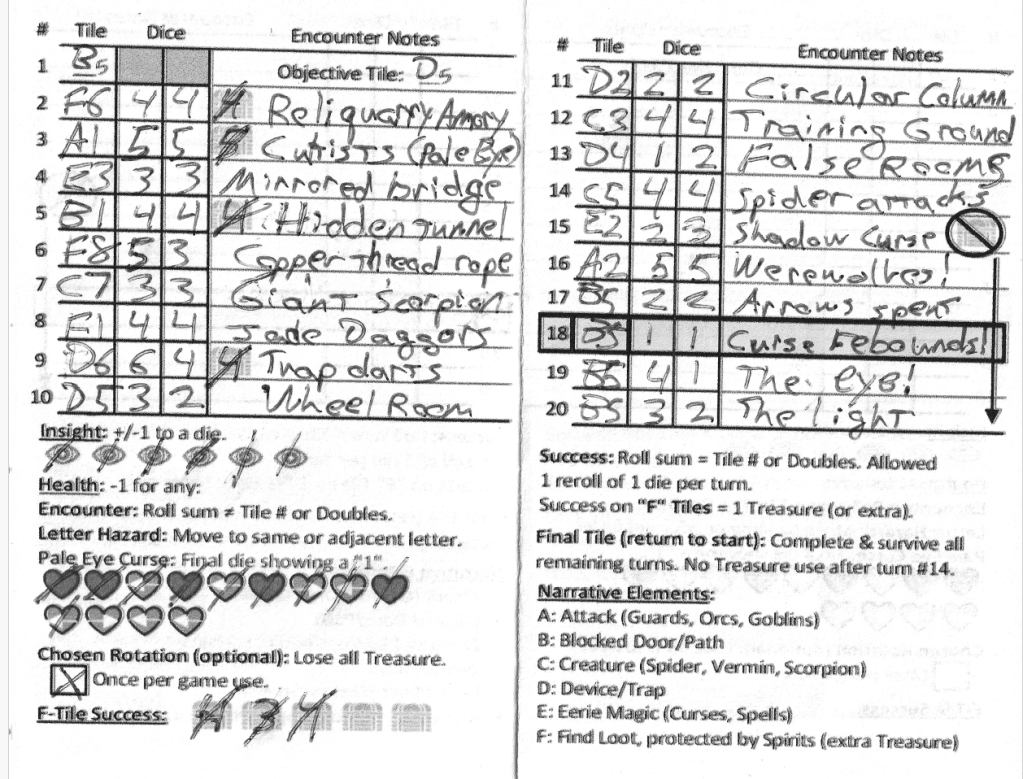
My completed “Shift of Fate” booklet.
Shift of Fate is a very different game from the official Evermorph Dungeon solo rules. I like these rules as well, but they are a bit more challenging. I recommend watching the short video before you play.
Most roleplaying games (RPGs) have numbers, called ‘stats’, that define a characters’ abilities, the enemies’ strengths, and an obstacle’s challenge level. The stats in Shift of Fate are less obvious. The clear one is Health, but it is also the mechanic that usually determines when the Evermorph cube sections rotate. Insight is an expendable resource, but it feels like a stat. Narratively, it comes into play a lot. You will probably use treasure as quickly as you gain it. Therefore, the treasures and how your character uses them influence the narrative as much as any stat would, and I see that as the final stat in the set.
Because these were not stats on a character sheet in a traditional sense (e.g., Strength, Intelligence, Armor Class), I was inspired to send a party of adventurers together into this game. I realized I could treat the wound track as shared between the party, injure them separately in the narrative, and even let some of them die if it felt appropriate.
Of course, more named characters means a longer story. This one is a lot longer than Thiovar’s first adventure as a result. Gameplay-wise, Shift of Fate plays to twenty turns (unless you die first) and the official solo rules do not have a set number of tiles or turns. In my case, there were only eleven tiles explored in the first game (including returning to F5), and in the second game I visited 17 tiles (counting B5 twice and repeats from the first adventure).
The official solo game provides a bit more guidance on using the narrative elements of each tile and moving between them whereas Shift of Fate provides more backstory and an enemy through two different introductions (read them both!). I reinterpreted these introductions and their setting elements. The Pale Eye and the Rangers of the Watch are both taken from Shift of Fate. As a ‘hunter’, Thiovar was halfway to being a D&D-style Ranger anyway, so that was an easy fit. The objective of Shift of Fate is to reach an ‘Anchor Chamber’ to switch the tile where you first entered the dungeon into an exit and escape. I could have followed the introduction and had Thiovar tricked into returning, but when I decided to make it a party I thought they should voluntarily enter together. So, I used the concept of the anchor chamber but made it a location where the heroes could take control of and unleash Evermorph!
I like the idea of the areas my character has previously explored retaining their history, even if changes occurred due to the passage of time and the actions of others. I spent a lot of time during the game re-reading my first adventure when I approached and explored these repeat chambers. It was very rewarding.
Oh, I was definitely ‘gaming’ this system as I moved through the dungeon, and around the cube. Knowing I wouldn’t be able to use treasure after a certain point ensured I’d use it up first, which means, if you’re carefully reading, you may notice me using insights before I have much treasure, then using treasure, then the characters become more insightful again.
You really need to game this system. If you aren’t keeping careful track of the consequences of the next wound, you could easily be pushed far off course and lose the game. I think this is a strength of Shift of Fate and it helped bring out the best in Evermorph.
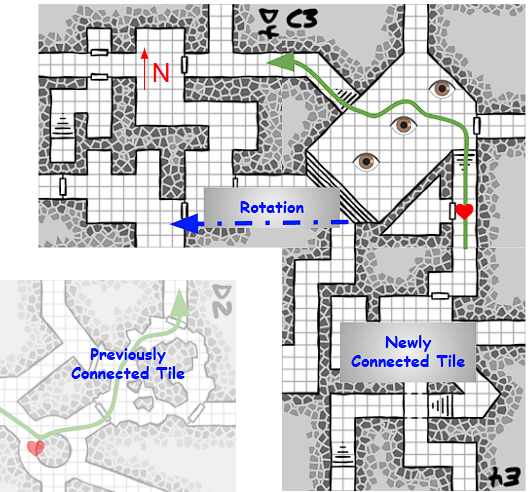
The twisting rules felt better in this game than the official version. Twisting left or right from the direction of entry onto the tile feels like a narrow escape or something pursuing you and cutting off an avenue of retreat. It also gives you an immediate option to turn around and explore something new that is now behind you. The official solo rules have you rotate the row or column in the same direction that you entered. That’s straightforward, but it can feel like something happening at a distance from your character.
The Shift of Fate rules keep your compass directions consistent, if you follow them closely. This isn’t important in play when you have the cube to reference and you can say, “That way,” and point, but narratively it can provide some useful guideposts and the opportunity to incorporate navigational themes—the rising sun, the northern wastes, the mystery of the west, the warmth of the southlands, etc. [For the record, I’m glad there aren’t cardinal directions on the Evermorph cube itself. It’s best to leave that up to the individual or group, but the method of consistency here is a nice addition.]
In the end I scored a measly five points. Well, a win is a win—I’ll take it! I didn’t put the final score in the story, despite my LitRPG pretensions, because it didn’t feel like it belonged in the narrative. The scoring is cute, but I’m not interested in playing for the challenge. If I play Shift of Fate again, it will be for the story. I love that the game can accommodate both “Story Now!” and “Step On Up!” play agendas.
A few more notes on the writing of the story. I edited it more thoroughly than the first adventure and was, overall, less interested in conveying the experience as closely as possible than in making the narrative enjoyable. Of course, I understand if you don’t see it that way as the changes in tense, style, and length make the two parts rather dissimilar. It’s okay if you like the first adventure better!
This time I wrote in past tense, which is more natural to write, but can be less immediate in the reading. I was far more focused on the writing experience and the narrative, partly because I was using a returning character that I now knew more about and partly I was influenced by the introduction and different play-style of Shift of Fate.
As I mentioned in the earlier companion post, around the same time I was playing these games I was also listening to Galahad and the Grail by Malcolm Guite (that’s the Amazon link, but I borrowed the audiobook from the library). I love that book! I was so into it that the meter and rhyme spilled out onto the page. I wasn’t trying to match Malcom’s incredible life’s work in quality or style, I just enjoyed exercising those poetic muscles. It’s not as consistent as I would like, but I thought completing the blog post so people could read the next adventure took precedence over turning this journaling RPG actual play into a proper epic poem.
Let me know if you are interested in reading more LitRPG solo adventures. I have a few other journaling RPGs I haven’t tried. If I receive a few responses I will likely write more posts like these.
Attribution:
Maps © Evermorph Studios (https://evermorphstudios.com)
Maps created with Dungeon Scrawl (https://dungeonscrawl.com) — used under CC BY 4.0 license.
 Arthur P. Dutton
Leave a comment